Author  ·  Doctoral Researcher  ·  CHRO  ·  Leadership Thinker

Vikram
Jit Singh

Leadership  ·  Decision-Making  ·  Organisational Resilience  ·  Harvard Business School

Most organisations are not underperforming.
They are systematically underusing the people they already have.
And the people inside them know it before the dashboards do.

That is not a talent problem. It is a design problem, installed in how roles are scoped, decisions are structured, and leadership changes under pressure. It compounds silently. Decision quality erodes. Earlier signals get missed. They lose the people who eventually choose clarity over captivity, and the capability quietly exits with them.

Over two decades inside complex, high-stakes organisations, and formal research into how leaders decide when the pressure is real and the answers are not clear. I have come to recognise this pattern as structural, not situational. That is what this work examines.

Quiet
Waste
Scroll

Intellectual Territory

The Question I Keep
Returning To

Most organisations are better managed than they are led. The management, in many cases, is impressive. What it cannot see, and what it quietly fails to use, is the very capacity it needs to grow.

The hard question is not why organisations fail. It is why well-managed organisations, with strong systems, credible leaders, and capable people, produce less than they could.

The answer lives in structure: how roles are designed, how decision authority is distributed, how leadership calcifies under pressure, and how culture eventually justifies all three. When these forces compound, the cost is not a productivity dip. It is strategic stagnation. Decisions get shaped by people operating below their ceiling. They miss the signals that people working closer to their full capability would have caught. The capability quietly exits, and no dashboard captures the departure.

This work emerges from two things operating together: over two decades inside organisations navigating this at scale, and doctoral research tracing the empirical mechanism underneath it. The combination produces not a collection of observations, but a recognition of patterns, structural enough to surface across organisations of different sectors, sizes, and geographies.

The Central Argument

Most organisations are designed to manage their people.
And that design is destroying the very capacity they need to grow.

From The Quiet Waste  ·  Introduction

The Framework

The Quiet Waste Cycle

Four interdependent movements, each sustaining the next. Not a list of problems: a self-reinforcing system that operates in every well-managed organisation that has stopped asking the right questions.

01
Movement 1
System Design
Organisations structure roles, metrics, and decision authority in ways that cap the expression of the people inside them. The ceiling is installed before anyone arrives. Rarely intentional. Almost always consequential.
02
Movement 2
Individual Response
Capable people read the environment accurately. They stop stretching towards what the system does not reward. Career captivity follows. Silence compounds the cost. The professional becomes what the environment allowed, rather than what they were capable of being.
03
Movement 3
Leadership Drift
Leaders, isolated by authority and operating under sustained pressure, lose calibration. They drift towards the behaviours they once resented. The honest feedback that might correct the drift stops arriving precisely when the need for it is greatest.
04
Movement 4
Cultural Calcification
What leaders tolerate becomes normal. What is normal becomes the culture. The culture then justifies the original system design. The cycle closes. It begins again. Each rotation costs more than the last.

The Vocabulary

A Working Language
For What Organisations
Stop Seeing

A working language, organised by movement of the cycle. Not techniques to apply: vocabulary for naming what is already happening.

Movement 1  ·  The System We Inherited
The Quiet Waste
Underutilisation as design failure. The gap between what people are capable of and what the organisation has made room for.
The Comfortable Illusion
Three compounding illusions the paper organisation cannot close: the Role Illusion, the Metric Illusion, the Structure Illusion.
The Holding Pattern
The architecture of deferral. Decisions circle, fuel burns, the runway stays uncleared because no one has been structurally empowered to clear it.
The Decision Cast
Three roles most approval processes conflate. The Decider holds and is empowered to close. The Voices shape but do not ratify. The Carriers execute or live with the decision and need to know what was chosen and why. Governance is the architecture inside which the three operate, not a fourth role.
The Politics Spectrum
Three modes of influence in organisational life. Legitimate Influence: credibility built through contribution. The Grey Zone: visibility management and selective framing, common but worth examining. Destructive Manipulation: patronage, credit-capture, advancement through access rather than contribution. Leaders cannot eliminate politics. They decide which kind their organisation rewards.
Movement 2  ·  The Career We Navigate
The Walk-Out Test
If you walked out of your role tomorrow, what would still be yours? Borrowed Security stays behind with the title. Built Security travels with you.
The Silence Tax
The cost of waiting to be noticed. Year by year, what begins as discretion becomes habit, and habit becomes identity. The professional becomes smaller than they are because the environment never asked them to stay legible. Closed mouths do not get fed.
The Legibility Ladder
Four levels at which contribution becomes legible to the organisation. Level One: Delivering Reliably (invisible by design). Level Two: Making Outputs Visible. Level Three: Making Judgement Visible. Level Four: Making Future Contribution Visible. Each level gives leaders something more specific to respond to.
The Career Hedge
A protective position taken under uncertainty, in three layers: the Foundational Layer (durable human capabilities), the Growth Layer (capabilities the field is moving towards), the Experimental Layer (capabilities you are hedging into without yet knowing the direction).
The Merit Ceiling
The point at which performance alone stops carrying a career. Above it, advancement requires co-ownership: a senior partner whose own standing is staked on yours. Earned by becoming someone worth co-owning, not by asking.
Movement 3  ·  The Leader We Become
The Slowness of Good Judgement
Speed compromises judgement where urgency is manufactured. Judgement erodes through four structural mechanisms produced by senior authority itself: time compression, information narrowing, success-induced overconfidence, decision fatigue.
Becoming What You Resented
Power does not corrupt. It exposes. The inner work begins before the exposure, in the disciplines that make a leader visible to themselves.
The Interior Life of Leadership
The structural loneliness of senior authority cannot be solved by more vulnerability. It requires the deliberate construction of honest spaces in which thinking remains possible.
Movement 4  ·  The Culture We Build
The Tolerance Audit
Three observations that name the culture you actually have: the behaviour you permit, the pattern of advancement, the unofficial version.
The Departure Dividend
Every departure is an act of publication. Adversarial exits are produced by reduced investment after notice, exit conversations treated as compliance, and no contact afterward. Advocate exits are produced by sustained investment, honest dialogue, and meaningful alumni connection. The departing employee carries the most credible account of your culture into the market.
The Pulled Punch
What gets withheld is invisible, which is why it is rarely measured and almost always larger than leaders realise. The conditions that release the punch are structural, not motivational.
From Waste to Fuel
The synthesis. The waste is co-produced. The release is co-released. Where one side starts honestly, the other side has either to respond honestly, or to reveal itself as unwilling. Either is information. Both are forward motion.

A Body of Work

One Question.
Three Angles.

This is not a single book. It is the beginning of a sustained examination of one question, why organisations systematically underuse the capacity they need to compete, approached from three distinct but connected angles.

These are not separate projects. They are one argument, examined at increasing depth. The goal is not to publish books. It is to build the vocabulary, the evidence, and the framework through which organisations can finally see, and name, what they have been losing.

The Phenomenon
The Quiet Waste
What happens inside organisations when capability goes unrealised: the structural cycle through which well-managed organisations underuse their best people.
The Mechanism
Doctoral Research
The empirical layer: tracing the tested chain from a leader's emotional disposition through decision behaviour to organisational resilience. The mechanism underneath the phenomenon.
Forthcoming
The Diagnostic
A Framework for What Is Lost
A rigorous framework for measuring what organisations lose: translating the research and the Quiet Waste Cycle into a diagnostic organisations can act on.

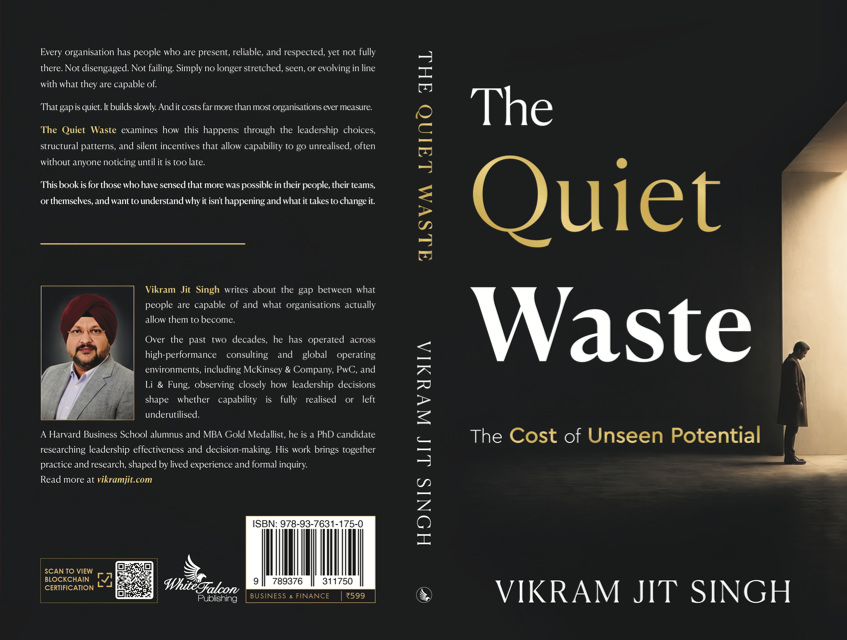
The Book

The Quiet Waste: The Cost of Unseen Potential by Vikram Jit Singh
The
Quiet
Waste
Vikram Jit Singh
Coming Soon

The Quiet
Waste

The Cost of Unseen Potential

Every organisation has people who are present, reliable, and respected, yet not fully there. Not disengaged. Not failing. Simply no longer stretched, seen, or evolving in line with what they are capable of.

That gap is quiet. It builds slowly. And it costs far more than most organisations ever measure.

The Quiet Waste examines how this happens: through the leadership choices, structural patterns, and silent incentives that allow capability to go unrealised, often without anyone noticing until it is too late.

This book is for those who have sensed that more was possible, in their people, their teams, or themselves, and want to understand why it isn't happening and what it takes to change it.

  • Part I The System We Inherited  ·  Chapters 1–4: How organisations actually work, and what that costs
  • Part II The Career We Navigate  ·  Chapters 5–7, with an Interlude (The Disruption Tax): The unwritten rules of growth, stagnation, and getting out
  • Part III The Leader We Become  ·  Chapters 8–10: The inner and outer architecture of leadership
  • Part IV The Culture We Build  ·  Chapters 11–14: What sustainable, credible organisations actually require
What will you design?
Follow the Work

When the book is published. When new essays appear. Occasional writing on leadership, capability, and what organisations lose when they stop asking the harder questions. Nothing else.

Intellectual access, not a newsletter. Infrequent by design.

Doctoral Research

The Empirical Layer

The book describes a phenomenon. The research traces the mechanism underneath it.

My doctoral research examines a question that sits at the core of The Quiet Waste: when organisations face disruption, what determines whether a leader's decisions hold up?

The study proposes and empirically tests a process model: tracing the path from a leader's emotional disposition, through their habitual decision style, to the quality of their decisions, to the resilience of their organisation.

The central finding is this: emotional disposition reaches organisational resilience exclusively through the decision-making chain. There is no direct path. Personality alone does not build resilience. How a leader habitually decides does.

This reframes what leadership development should target: not trait profiling, but decision process quality. A capability that is directly trainable.

The Tested Model
Emotionality Decision Style Decision Quality Resilience

Emotional disposition shapes decision habit. Decision habit shapes decision quality. Accumulated decision quality builds the organisation's capacity to anticipate disruption, cope under pressure, and adapt over time.

Methodology

Mixed-methods design. Quantitative strand: PLS-SEM with N=220 senior leaders across six Indian cities and four sectors. Qualitative strand: 20 in-depth interviews, with each theme mapped directly to a quantitative path. The design tests the model and explains what the numbers show.

Implication for Practice

Leadership development has long focused on who a leader is. The evidence suggests the more productive question is how they habitually decide, and whether that decision process holds up when the pressure is real and the answers are not clear.

220

Senior Leaders
in Study Sample

6

Cities Across
India

20

In-Depth
Interviews

Writing

The Live Edge

Short-form thinking, before the framework sets. Twenty-eight essays, organised by the four movements of the Quiet Waste Cycle.

The book names the phenomenon. The research traces the mechanism. The essays test the edges.

Read all essays →

About

Vikram Jit Singh

Vikram Jit Singh writes about the gap between what people are capable of and what organisations actually allow them to become.

Over two decades, he has operated inside high-performance consulting and global operating environments, including McKinsey & Company, PwC, and Li & Fung, observing closely how leadership decisions shape whether capability is fully realised or quietly left behind.

A Harvard Business School alumnus and MBA Gold Medallist, he is a PhD candidate researching how leaders make decisions under disruption and what that means for the organisations they lead. His work brings together over two decades of lived practice and formal empirical inquiry.

He is based in New Delhi, India.

Harvard Business School
Senior Executive Leadership Program · Alumnus
PhD Candidate
Leadership & Decision-Making Effectiveness · BML Munjal University
MBA (Human Resources)
Gold Medallist
McKinsey & Company / PwC / Li & Fung
Over two decades of senior HR leadership across Asia, Africa & Europe
Affiliations
Harvard Club of India · Society for Human Resource Management (SHRM) India · National HRD Network (NHRDN) · Academy of Human Resource Development · Delhi Management Association (DMA)

Speaking & Advisory

Engagements Built
Around the Ideas

Keynote & Conference
The Quiet Waste: What Organisations Lose and Why They Don't See It
For leadership conferences, senior executive forums, and organisational offsites where the question of capability, culture, and leadership effectiveness is on the agenda. Framed around the Quiet Waste Cycle and what interrupting it requires.
Board & Leadership Advisory
Organisational Capability Diagnosis
For boards and senior leadership teams who want to understand, with rigour, where their organisation is losing capability, why it is happening, and what a structural response looks like. Advisory built around the framework, not a generic audit.
Research & Academic
Decision Quality as the Mechanism of Resilience
For research seminars, business school programmes, and executive education contexts. Presents the doctoral research, the tested process model linking emotional disposition, decision style, and organisational resilience, and its implications for leadership development.
Executive Education
Leadership That Holds Under Pressure
For senior leadership cohorts navigating disruption. Draws on both the empirical research and over two decades of practice to examine how leaders decide when the pressure is real, the answers are unclear, and the cost of drift is already accumulating.
For speaking and advisory enquiries
vikram@vikramjit.com